
Many vehicles monitor whether their bulbs are working properly. An LED bulb draws far less current than a filament bulb: the vehicle may think it is faulty and display an error message.
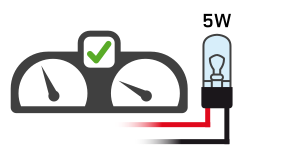
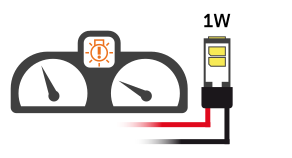
The error threshold is often lower than the original wattage: a 2W LED in place of a 5W bulb often works without an error. This varies from vehicle to vehicle.
3 ways to avoid the error message
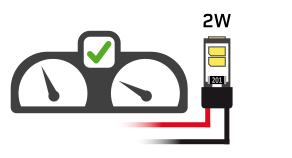
1. A “CAN bus” LED bulb
The simplest and cheapest option: a built-in resistor increases the bulb’s current draw, for example the D-A12. Limited to bulbs under 10W, it is not sufficient on some vehicles, and its heat can shorten the bulb’s service life.
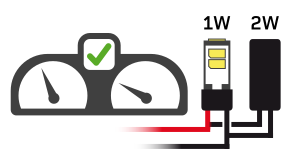
2. An external resistor
It is wired in parallel with the bulb, for example the D-533, and is suitable for all bulbs, even above 50W. The wiring must be accessible. The resistor gets very hot and is best installed outside the headlight.
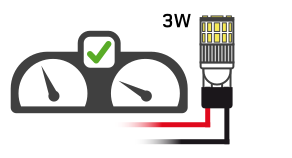
3. A more powerful LED bulb
Ideal if the vehicle’s error threshold is low. An LED always draws less than the original bulb: a maximum of around 3W for a W5W, 8W for a P21W.
Does your vehicle monitor its bulbs?
With the ignition off, remove the bulb to be replaced, then start the engine. If a faulty bulb message appears, your vehicle has this monitoring.
An error despite a CAN bus bulb?
This can happen on more sensitive vehicles, such as the VW Golf 6 and 7, Audi Q5 or Fiat 500. In that case, a specific bulb or an external resistor is required. Contact us, stating your vehicle model.